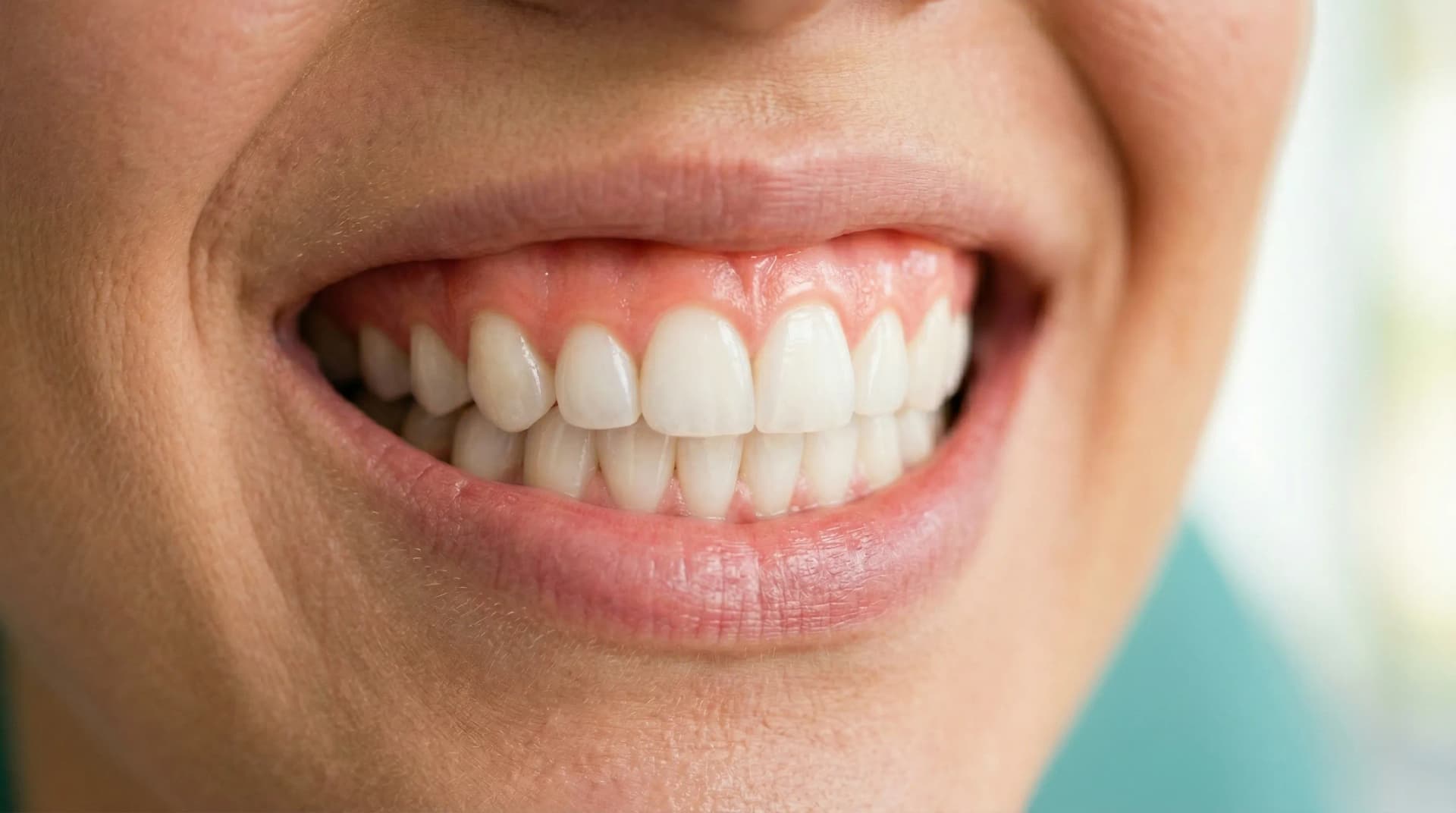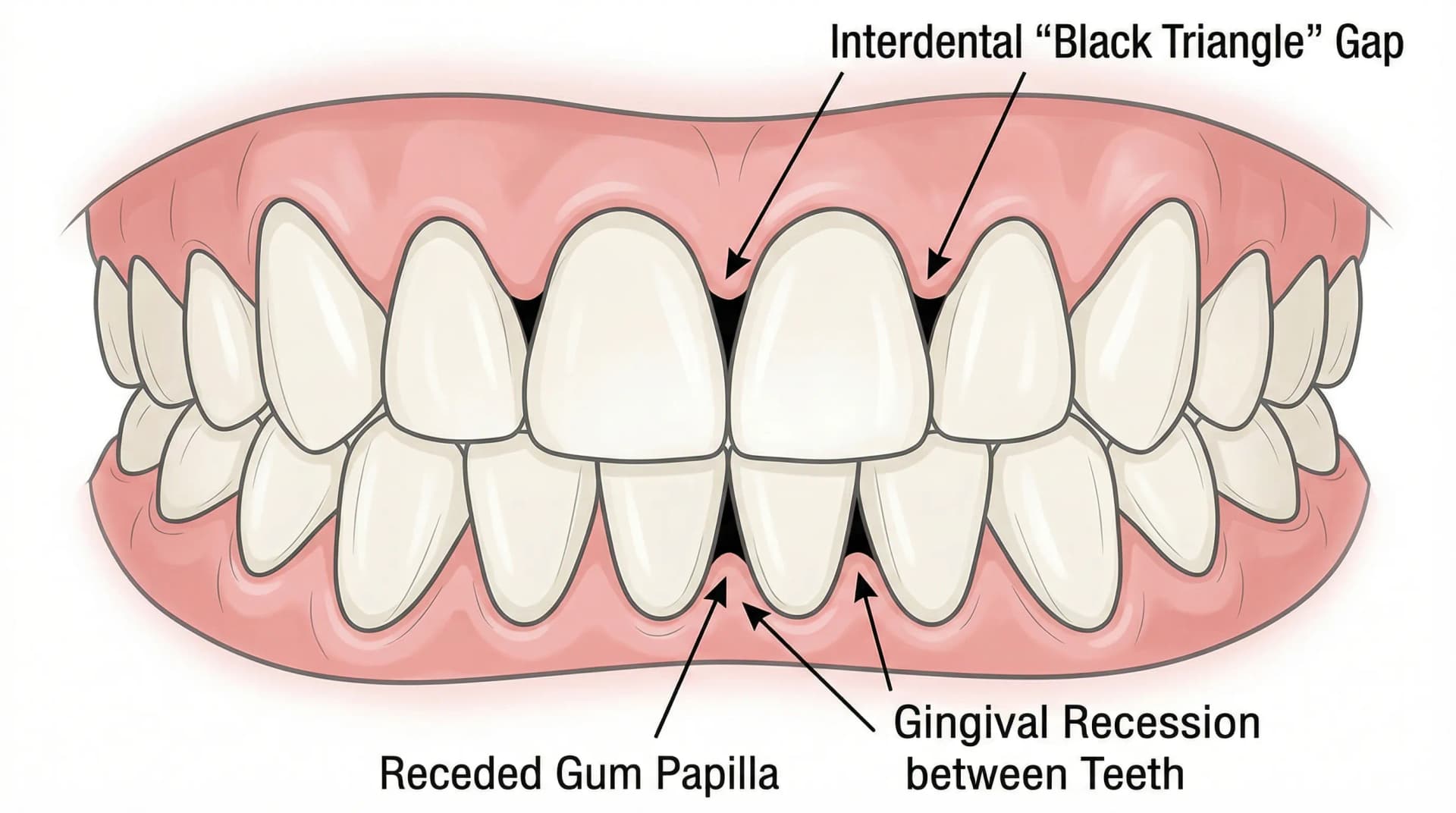
Black triangles between teeth — clinically known as open gingival embrasures — are dark, triangular gaps that appear when gum tissue no longer fills the space between teeth. They're caused by gum recession, bone loss, divergent tooth roots, or thin tissue anatomy. While not always dangerous, they may signal underlying periodontal issues and can trap food. Several treatment options exist, from cosmetic bonding to gum grafting.
You might first notice them in a photo. Or maybe in the mirror under certain lighting. Those dark, triangular gaps between your teeth where the gum tissue used to fill in completely — they have a name. Dentists call them open gingival embrasures, but most people know them as black triangles.
They're more common than you might expect. A 2013 study in the Journal of the American Dental Association found that open gingival embrasures were present in 67% of people over age 20. And while they're often dismissed as purely cosmetic, they can actually tell you something important about what's happening beneath your gums.
What Exactly Are Black Triangles?
In a healthy mouth, the gum tissue between your teeth — called the interdental papilla — fills the entire space between adjacent teeth, forming a tight, pointed triangle that meets at the contact point where the teeth touch. This papilla acts as both a seal against bacteria and food, and a cosmetic feature that gives your smile a uniform, healthy look.
A black triangle appears when this papilla shrinks, recedes, or fails to fully fill the embrasure space. The result is a visible dark gap — "dark" because you're seeing the shadow of the empty space behind the teeth.
The condition is most noticeable between the upper front teeth, where the embrasure spaces are most visible. But black triangles can appear anywhere in the mouth.
What Causes Black Triangles?
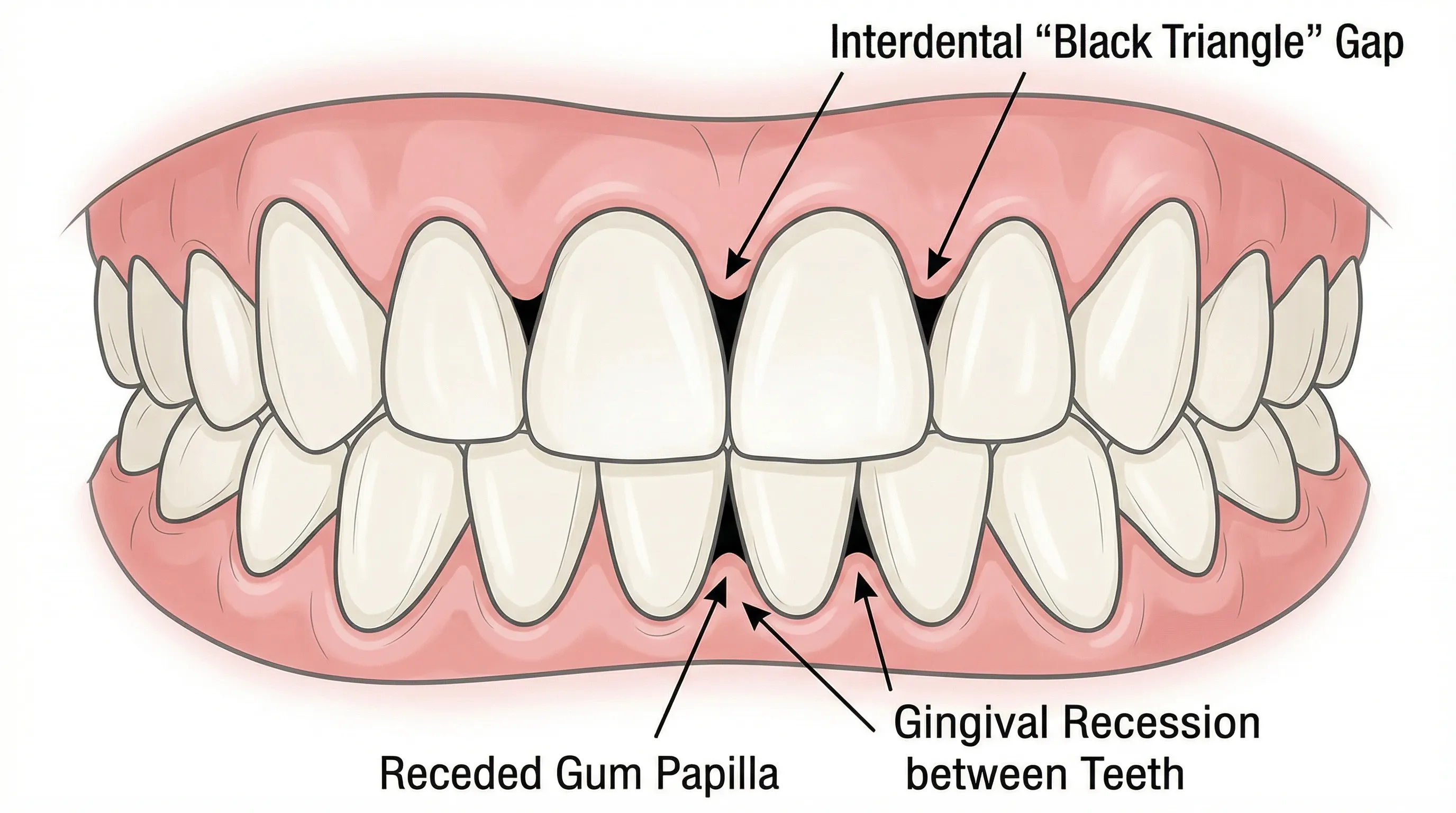
1. Gum Recession and Bone Loss (Periodontitis)
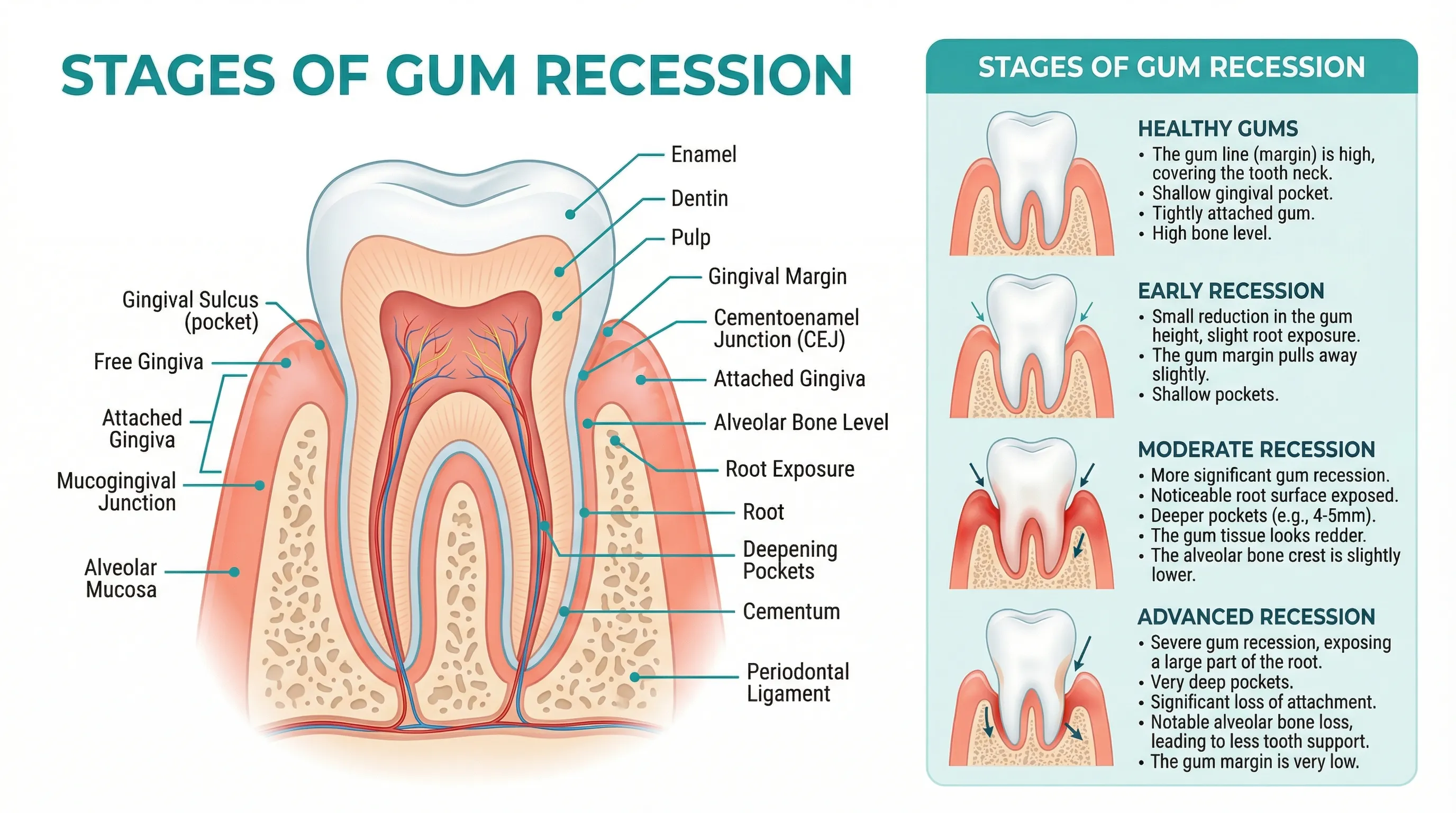
This is the most common pathological cause. Periodontal disease destroys the alveolar bone — the bone that supports your teeth — and the gum tissue that sits on top of it follows the bone downward. As the bone between two adjacent teeth (the interdental septum) is lost, the papilla that was supported by that bone can no longer fill the space.
A 2010 study in the Journal of Periodontology by Tarnow, Magner, and Fletcher established a critical relationship: when the distance from the contact point between two teeth to the top of the underlying bone (the crestal bone) exceeds 5 millimeters, the papilla is almost never fully intact. Below 5 mm, the papilla fills the space most of the time.
This bone-to-contact-point distance is the single most important factor in whether a papilla will be present or absent.
2. Orthodontic Treatment
This is one of the most frustrating causes for patients. You invest in braces or clear aligners to straighten your teeth, and then you notice black triangles that weren't there before. How does this happen?
Several mechanisms are at play:
- Crowded teeth hide the gaps. When teeth are overlapping, the embrasure spaces are concealed. Once teeth are aligned, the true shape of the underlying bone and gum tissue is revealed.
- Tooth movement through bone. Moving teeth through the jaw can result in changes to the bone architecture between teeth. If the roots diverge after alignment, the bone between them may be thinner.
- Thin biotype tissue. Some people naturally have thin, delicate gum tissue that is more prone to recession during orthodontic movement.
A 2017 study in the American Journal of Orthodontics and Dentofacial Orthopedics reported that black triangles were the most common undesirable side effect of orthodontic treatment, with prevalence rates as high as 38% to 48% in adults undergoing clear aligner therapy.
3. Divergent Root Anatomy
The shape and angulation of tooth roots directly influence whether black triangles form. Teeth with roots that diverge away from each other (rather than running parallel) create a wider embrasure space at the gum line. Even with perfectly healthy bone levels, the papilla may not stretch enough to fill this wider gap.
The upper central incisors are particularly susceptible because their roots naturally have some degree of divergence.
4. Tooth Shape: Triangular Crown Form
Teeth that are wider at the biting edge and narrower at the gum line (a pronounced triangular shape) naturally have a larger embrasure space. The contact point between such teeth is positioned high and narrow, leaving more room for a visible gap below.
This is an anatomical variation — not a disease — and some people are simply more prone to black triangles because of the shape of their teeth.
5. Age-Related Changes
Gum tissue naturally thins and recedes with age, even in the absence of periodontal disease. The American Academy of Periodontology notes that gum recession increases significantly after age 40. As the interdental papillae gradually shrink over decades, black triangles can appear in older adults who have otherwise maintained good oral health.
6. Aggressive Oral Hygiene
Paradoxically, overzealous brushing or improper use of interdental tools can damage the delicate papillae and cause them to recede. Repeatedly forcing a toothpick or oversized interdental brush into a tight embrasure space can traumatize the tissue over time.
Are Black Triangles Dangerous?
In themselves, black triangles are not a disease. However, they may be a sign of one (periodontitis), and they do create some practical problems:
- Food trapping. Open embrasures are notorious for catching food particles, which can lead to localized decay — potentially progressing through the stages of tooth decay — and further gum irritation if not cleaned out.
- Aesthetic concern. Many people find black triangles — especially between the front teeth — cosmetically distressing. Research in the British Dental Journal (2014) found that open gingival embrasures were rated as one of the most unappealing aesthetic features of a smile, second only to missing teeth.
- Speech effects. In some cases, air escaping through the gaps can cause slight whistling sounds during speech, particularly with "s" and "f" sounds.
- Indicator of bone loss. If the black triangles are caused by periodontitis, they're a visible marker that bone support is being lost — a condition that may eventually threaten the stability of the teeth themselves.
If you notice new black triangles forming, it's worth having your dentist evaluate whether underlying bone loss is contributing to the problem.
Treatment Options
The good news is that several treatment approaches can address black triangles, ranging from minimally invasive cosmetic procedures to surgical interventions. The right choice depends on the cause, severity, and location.
1. Composite Bonding
A dentist applies tooth-colored composite resin to the adjacent teeth, reshaping them to close the gap. This is one of the simplest and most affordable options.
How it works: The teeth on either side of the black triangle are built out slightly at the gum line so they contact each other lower, eliminating or reducing the visible gap.
Pros: Conservative (no removal of tooth structure), reversible, same-day procedure, relatively affordable ($150-$400 per tooth).
Cons: Composite can stain over time, may need replacement every 5-10 years, and makes flossing the area more technique-dependent.
2. Porcelain Veneers or Crowns
For a more permanent and stain-resistant solution, porcelain veneers can be shaped to eliminate black triangles while simultaneously addressing other cosmetic concerns.
Pros: Excellent aesthetics, long-lasting (10-20+ years), stain-resistant.
Cons: More expensive ($1,000-$2,500 per tooth), requires removal of some tooth enamel (irreversible), and still requires proper planning to avoid food trapping.
3. The Bioclear Method
This is a relatively newer technique that has gained popularity specifically for treating black triangles. Developed by Dr. David Clark, Bioclear uses heated composite resin injected into a clear matrix form that wraps around the tooth at the gum line.
How it works: Unlike traditional bonding (which builds material onto the tooth surface), Bioclear creates a seamless, anatomically shaped restoration that fills the embrasure space from the inside out.
Pros: More natural contour than traditional bonding, better adaptation to the gum tissue, may reduce food trapping compared to other restorative options.
Cons: Requires a dentist trained in the Bioclear technique, costs more than traditional bonding ($300-$600 per tooth), and long-term data is still accumulating.
4. Hyaluronic Acid Injections
This is an emerging and genuinely exciting approach. Hyaluronic acid (HA) — yes, the same substance used in dermal fillers — has been studied for its ability to regenerate interdental papillae.
A 2016 randomized controlled trial published in the Journal of Clinical and Diagnostic Research found that injection of hyaluronic acid gel into the interdental papilla resulted in statistically significant papilla regrowth over a three-month period. A systematic review in the Journal of Clinical Periodontology (2019) confirmed these findings across multiple studies, though it noted that results were most consistent for mild to moderate black triangles (Class I-II on the Nordland-Tarnow classification).
How it works: Small amounts of HA gel are injected directly into the base of the receded papilla, stimulating the tissue to expand and fill the embrasure. Multiple sessions (typically three to five, spaced two to three weeks apart) are usually needed.
Pros: Minimally invasive (injection only), no tooth modification, may stimulate actual tissue regeneration.
Cons: Results are not always predictable, multiple sessions required, not yet widely available, and limited long-term data beyond two to three years. Most effective for mild cases.
5. Gum Grafting
For black triangles caused by significant gum recession, soft tissue grafting may be an option. A periodontist transplants gum tissue (from the palate or a donor source) to rebuild the area.
Pros: Addresses the root cause (lost tissue), long-lasting results when successful.
Cons: Surgical procedure with recovery time, not always predictable for papilla regeneration specifically (grafting works better for facial/buccal recession than for rebuilding the pointed papilla between teeth), and higher cost ($600-$1,200 per site).
6. Orthodontic Adjustment
In cases where black triangles resulted from orthodontic treatment, further tooth movement can sometimes help. Techniques include:
- Interproximal reduction (IPR): Tiny amounts of enamel are removed from the sides of adjacent teeth, and the teeth are then moved closer together to close the gap.
- Uprighting roots: If roots are divergent, orthodontic mechanics can make them more parallel, which may allow the papilla to fill in.
A 2019 study in The Angle Orthodontist demonstrated that IPR combined with space closure was effective in reducing black triangle size in 75% of treated cases.
Prevention: What You Can Do Now
While some causes of black triangles (genetics, tooth shape, aging) are outside your control, there's plenty you can do to reduce your risk:
- Maintain excellent periodontal health. Gum disease is the most preventable cause of black triangles. Brush twice daily, floss or use interdental brushes daily, and keep up with professional cleanings.
- Use the right-sized interdental tools. An interdental brush or pick that's too large for the space can traumatize the papilla. Ask your hygienist to recommend the correct size for each area of your mouth.
- Brush gently with a soft-bristled brush. Aggressive brushing with a hard brush damages gum tissue over time. Use light pressure and small circular motions.
- Support your oral microbiome. Research increasingly suggests that a balanced oral bacterial community helps protect against the inflammatory processes that destroy gum tissue and bone. Be cautious with antiseptic rinses — some mouthwashes kill good bacteria along with the bad, potentially disrupting this balance.
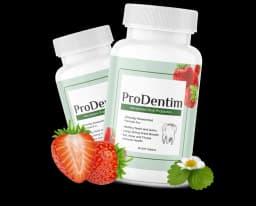
ProDentim
Oral Probiotic for Gum & Teeth Health
ProDentim contains oral probiotic strains like Lactobacillus reuteri and BLIS K-12 that research suggests may help maintain the oral microbial balance associated with healthier gum tissue — one piece of a broader prevention strategy.
We may earn a commission if you make a purchase through our links, at no extra cost to you.
- Don't smoke. Tobacco use accelerates both gum recession and bone loss, two primary drivers of black triangle formation.
- Discuss orthodontic risks upfront. If you're considering braces or clear aligners, ask your orthodontist about your risk for black triangles. Understanding the possibility ahead of time allows for preventive strategies like IPR during treatment.
When to Be Concerned
Not every black triangle needs treatment. A small gap between the lower front teeth that has been there since your twenties and isn't getting larger may simply be an anatomical feature. But you should see your dentist if:
- Black triangles are new or getting larger — this may indicate active bone loss from periodontal disease
- You're experiencing bleeding, swelling, or tenderness around the affected areas
- You notice increased food trapping — this can lead to decay and further gum problems if not managed
- The gaps appeared after dental treatment — improperly contoured fillings, crowns, or orthodontic work may need adjustment
- You're bothered aesthetically or functionally — treatment options exist, and a dentist can help you evaluate which approach makes the most sense for your situation
Living With Black Triangles
If you have mild black triangles that aren't caused by active disease and aren't bothering you functionally, it's perfectly reasonable to simply monitor them. Use a water flosser or interdental brush to keep the open spaces clean, see your dentist regularly to track any changes, and focus on maintaining the gum and bone health you still have.
If exposed roots from recession are causing sensitivity to cold temperatures, that's another reason to address the issue sooner rather than later. For those who want to address them cosmetically or are dealing with problematic food trapping, the range of treatment options has never been broader. From simple composite bonding to the promising frontier of hyaluronic acid injections, there are solutions for nearly every situation and budget.
ProDentim
Oral Probiotic for Gum & Teeth Health
Protecting the gum tissue and bone you have is the best prevention against worsening black triangles. ProDentim delivers probiotic strains that research suggests may support the microbial balance linked to healthier gum tissue.
We may earn a commission if you make a purchase through our links, at no extra cost to you.
The most important step is getting an accurate diagnosis. A dentist can determine whether your black triangles are a cosmetic concern, an early sign of periodontal disease, or something in between — and recommend the most appropriate path forward.
Related reading: